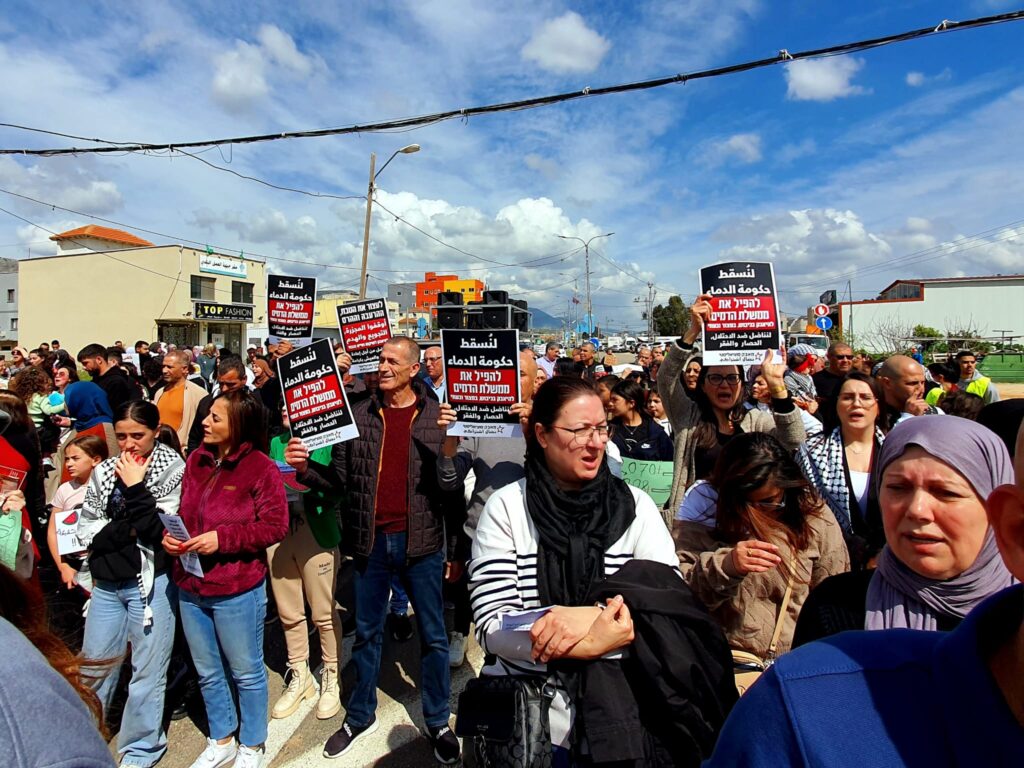
The Socialist Struggle Movement shares the aspiration to mobilise a mass vote to remove Netanyahu and the far right’s capitalist government of death. We will work to strengthen a protest vote for the Joint List, as a voice against the ‘forever war’ and the occupation, and against austerity and privatisation, while calling for the advancement of a socialist and class-based left alternative that cuts across ethnic and national divides.
The final stretch before polling day is marked by acute uncertainty. Despite mass revulsion at the existing state of affairs and cross-community hopes for the defeat of Netanyahu’s rule at the ballot box, deep pessimism prevails regarding the potential for real change in people’s lives.
Public discourse in Israeli society has been hijacked into the dead end offered by the debate between the two blocs of the political parties of occupation, war and the rule of capital. The debate between the establishment parties concerns the responsibility of Netanyahu and his partners for the atrocities of 7 October and the abandonment of the hostages. Yet it contains no challenge whatsoever to the military campaign, the mass atrocities it has inflicted on Gaza and the region, or the bereavement and damage it has exacted from working-class and poor people in Israel. It fuels the myth of a ‘war of no choice’ and does not address the root causes of the immense crisis.
The parties of the Netanyahu bloc secured less than 50% of the vote in the 2022 elections and provoked mass movements and protest general strikes. Yet they received decisive assistance from the establishment parties of the ‘opposition’, and the Histadrut leadership, which mobilised in support of the military campaign. The ‘Change Bloc’, headed by former chief of staff Eisenkot and led by representatives of the generals’ and capitalists’ mainstream, promotes security demagoguery to normalise the repression and dispossession of millions of Palestinians. It also inflames the chauvinist conception that occupation — rather than an end to national oppression and peace founded on equality between the peoples — can provide secure lives for millions of Israelis.
The elections are taking place as the historic crisis of war continues to develop at varying levels of intensity, while Netanyahu’s regime continues to threaten further rounds of escalation on various fronts. Added to this are threats from the Trump administration, which is concentrating military forces in the region for possible attacks against Iran or the Houthis, despite its apprehension about the consequences on the eve of the US midterm elections. Even if renewed conflagration does not erupt immediately before the elections, it remains a prospect during the transitional period and under a new capitalist government of occupation.
Three years have passed since the surprise offensive and the atrocities involving the massacre and abduction of Jews, Palestinians and others, led by the right-wing, pro-capitalist Hamas movement as a false answer to the occupation and siege imposed on millions of Palestinians. That event provided a cynical pretext for the multifront ‘forever war’ and the genocidal assault on Gaza, with killing and destruction on a scale unprecedented in the history of the Zionist-Arab conflict. At the same time, aggression in the West Bank escalated, with extensive displacement of Palestinians, settler terror and the destruction of the livelihoods of masses of people. The international protest movement that arose influenced the dynamics that led to the Gaza ‘fire reduction’ arrangement and the exchange deal, and prompted symbolic sanctions against the settlements as governments sought to defuse mass anger.
The ‘forever war’ has sown death and destruction on an enormous scale throughout the region, including the occupation of territories in southern Lebanon and southern Syria, and a war aimed at advancing regime change in Iran. The assault on Iran also inflicted damage on the living conditions of masses of people around the world. It is one of the background factors behind a global wave of demonstrations and strikes over the cost of living and wider issues, from Syria to France.
The Israeli ruling class, which united around the military campaign led by Netanyahu’s regime, is divided under the impact of fears about trends towards the international isolation of Israeli capital, the destabilisation of society, the potential for a Palestinian uprising, and the possibility that settlement and annexation trends could lead to growing pressure for a ‘binational state’ — in which the millions of disenfranchised Palestinian subjects in the territories occupied in 1967 would be incorporated and create a Palestinian majority. Yet a consensus against territorial concessions prevails across the different wings of the ruling class.
The Netanyahu bloc is advancing an acceleration of ethnic cleansing to eradicate the ‘demographic problem’. Eisenkot claims to oppose annexation in the West Bank in order to prevent a ‘binational state’, but rejects both territorial concessions and the democratic demand for recognition of a Palestinian state. He calls for the strengthening of the settlements, against the backdrop of rampant settler terror. The ‘Democrats’ vaguely promote ‘separation’ as an alternative to annexation, while Bennett and Lieberman advocate partial annexation in the West Bank. Lieberman proposes replacing the Palestinian Authority with an ‘Israeli-Jordanian confederation’ for controlling the Palestinians.
Because the ‘Change Bloc’ seeks not to end but to fuel the burden of occupation and war — the future it offers young people — it relentlessly pushes the ‘equality of burden’ spin. This demands the expanded conscription of ultra-Orthodox youth into the war machine for the sake of equality in killing, alongside the imposition of ‘national service’ on Arab-Palestinian youth. This ‘divide and rule’ approach redirects public anger towards impoverished communities as scapegoats. And despite its attempt to harness anger over Netanyahu’s attempted ‘judicial coup’ and his regime’s authoritarian measures, including deepening exclusion of women in the public sphere, the ‘Change Bloc’ does not support the democratic demands to repeal the discriminatory ‘Nation-State Law’, to separate religion and state, and to abolish all discriminatory legislation.
For three years, Israel’s military industries, banks and retail chains have been raking in enormous profits, while the government and employers advance economic attacks on the working class to finance the machinery of war, occupation and settlements. The war consequently also serves as an instrument for extracting wealth, with the support of both establishment blocs and the right-wing, pro-war, pro-capitalist leadership of the Histadrut general federation. The Eisenkot bloc promotes policies that will perpetuate the cost-of-living crisis, particularly unaffordable housing and poverty wages. It does not advocate the extensive construction of public housing for all or rent controls, the taxation of luxury properties and the expropriation of control from the property giants. Nor does it demand genuine regulation and the expropriation of control from the retail giants.
In the face of a profound social crisis and soaring violence within the community, the Israeli centre-right bloc offers no end to the deliberate starvation of hospitals and social services through the taxation of billionaires, the reversal of privatisation, and public ownership and democratic control of the banks and the commanding heights of the economy for the benefit of society. As instruments of capitalism and Zionist national chauvinism, the parties of the ‘Change Bloc’ have no interest in such a transformation. Their agenda does not include guaranteeing a living wage throughout the economy or substantively strengthening organised labour. Their role is to ensure the ‘more responsible’ management of occupation, imperialist wars and the capitalist system.
Growing uncertainty
Uncertainty over the expected outcome has only increased in recent weeks. For now, it appears that most votes cast will be directed against the government. The centre-right bloc will benefit substantially from a ‘lesser evil’ vote, although it has failed to channel mass revulsion at the status quo into decisive support, and even its ability to form a minority government in the Knesset remains in doubt.
The fact that the conservative Raʿam (United Arab List / al-Muwaḥḥada) — identified with the southern tendency of the Islamic Movement and formerly a partner in the ruling coalition of ‘Change Government 1’ — has been excluded from the ‘Change Bloc’ from the outset makes it harder to project the appearance of majority support. Yet even with Raʿam, no majority for the bloc appears to be in sight.
As the election approaches, the increasingly precarious position of the Eisenkot bloc is becoming ever clearer. It is in a nominal dead heat, and it is entirely plausible that it could even finish at a disadvantage to the Netanyahu bloc — although the latter, too, appears nowhere near securing a majority coalition in the next Knesset, even if the satellite lists ‘Amcha Israel’ and ‘The Reservists and the Economic Party’, which serve as receptacles for right-wing populism seeking to absorb public anger, clear the electoral threshold.
The ‘Change Bloc’ is competing with the government over the continued maintenance of the occupation, the settlements and regional military aggression under the cover of security demagoguery, while the differences between the blocs are largely reduced to promises of differing degrees of credibility and responsibility. General Eisenkot himself, together with General Gantz, joined the present government for several months following 7 October 2023 — when support for the Netanyahu bloc had collapsed and was estimated at 45 seats — in order to shore up both the government and the war of extermination in Gaza. Chair of ‘The Democrats’ and a former deputy chief of staff, Yair Golan, repeatedly emphasised his support for the war, outflanked the government from the right with calls for military strikes, and criticised it principally for failing to advance ‘complementary’ measures to consolidate ‘military achievements’ through diplomatic agreements.
The generals are concentrated in the bloc opposing Netanyahu because of the continuing tensions between the government, led by forces of right-wing populism and the far right, and the senior officer corps, which, from a systemic standpoint, tends to be more apprehensive about losing control of events — yet they served as an engine of legitimation for government propaganda justifying the catastrophic war as ‘imperative’ for protecting the security of the Israeli public.
In doing so, they helped the Netanyahu bloc partially rebuild its support and strengthen the forces of the far right. Although, according to polling averages, the combined electoral weight of the far-right parties ‘Jewish Power’ and ‘Religious Zionism’ has not increased significantly since the 2022 election, and the latter, led by Finance Minister Smotrich, required an electoral bloc with Feiglin’s ‘libertarian’ Zehut to lift it above the electoral threshold, the boundary between varieties of right-wing populism and these parties has become blurred. The longer this government has remained in office, the more it has advanced parts of their programmes and provided backing for the flourishing of Kahanist-fascist gangs in the West Bank and beyond.
Eisenkot’s ‘Yashar!’ (Straight/Truthful) list is an electoral vehicle intended to present itself as a new product on the shelf, centred on the figure of Eisenkot, although it is largely a repackaging of the lists previously stitched together around Gantz, who has meanwhile been kicked to the sidelines in favour of a ‘new broom’. In the 2020 election, Gantz’s list (including ‘Yesh Atid’) secured 33 seats on the back of the ‘Anyone But Bibi’ vote and harnessed them to a government headed by Netanyahu. Now, an attempt to establish a joint government with Likud remains a possible scenario, just as Eisenkot joined such a government after 7 October. Yet given the political polarisation and the depth of mass revulsion at Netanyahu’s rule, the idea is deeply unpopular. If the political system fails to produce even the symbolic appearance of ‘rectification’, and instead delivers a symbolic victory image for the head of the blood-soaked government, it will only fuel mass anger. Eisenkot and his bloc partners have therefore distanced themselves from the idea.
The delegitimisation campaign dovetails with war propaganda
The traditional disqualification ritual in the Central Elections Committee, where government representatives enjoy an inbuilt majority, escalated under the impact of the war with the disqualification of the two largest lists among the Arab-Palestinian public, alongside those of Balad/at-Tajammuʿ chair Sami Abu Sheḥadeh and Hadash/al-Jabha MK ʿOfer Cassif (who, as part of political persecution, has since been convicted of ‘assaulting a police officer’).
The disqualifications were advanced in the knowledge that the state’s judicial arm, in the form of the High Court of Justice, would uphold most of the appeals against them. For its part, the High Court’s support for Abu Shehadeh’s disqualification, while overturning the others, reflects a combination of intensified persecution of Palestinian citizens of Israel amid the war crisis and the policing of the boundaries of permissible criticism of Israeli capitalism’s political regime — while maintaining the false appearance of a ‘pluralist’ bourgeois democracy, not least in an effort to stabilise national tensions.
This forms part of a campaign to delegitimise the political voice of Palestinian citizens of Israel and those among the Jewish population who consistently oppose the war of extermination and the occupation. The campaign as a whole undermines the legitimacy of any government not resting on a ‘Zionist majority’. For the Netanyahu bloc, from a weakened position, it also serves as a lever for delegitimising a cross-community ‘civic majority’ in society that has reviled the government from its first day, and for blocking a ‘Change Government 2’ that would rely on any form of support from parties based among the Arab-Palestinian population in Israel.
Under the ‘Basic Law: The Knesset’, a candidacy for the Knesset must be disqualified, among other grounds, for ‘incitement to racism’. The committee, of course, found no evidential basis for any such disqualifications. ‘Jewish Power’ and ‘Religious Zionism’ were given a clean bill of health. More generally, the parties responsible for advancing the ‘judicial coup’, the occupation and mass atrocities, including the crimes of ethnic cleansing and genocide, as well as the extensive assault on the living conditions of masses on both sides of the Green Line and around the world, passed every ‘democratic’ test.
The high point of the witch-hunt was the chauvinist disqualification of Abu Shehadeh, who withdrew on the recommendation of the High Court judges who supported his disqualification. A lawyer convicted of murder following a Kahanist attack against Palestinians in Jerusalem in 1992 represented ‘Jewish Power’, led by Police Minister Ben-Gvir, before the High Court. Until recently, Ben-Gvir boasted of displaying in his home a portrait of Baruch Goldstein, the perpetrator of the 1994 Cave of the Patriarchs massacre.
During the proceedings, establishment representatives who support the war of extermination engaged in sophistry over an article written from a nationalist ideological perspective that Abu Shehadeh published on 8 October 2023. Abu Shehadeh swiftly condemned the 7 October massacre on various occasions, but in that article, which addressed the atrocities of the occupation, he omitted any mention of it, claiming he was unaware, and presented the Hamas attack uncritically and as leverage for negotiations between the PLO and the occupying state. The censors were appalled by this, yet, as noted, politicians who demanded and acted to erase Gaza are regarded as legitimate public representatives.
The ‘Change Bloc’ joined the disqualification campaign, which dovetails with its own chauvinist war propaganda and the silencing of criticism of the war’s atrocities and the ‘security’ deception inflicted on working-class and poor people in Israel. This included ‘The Democrats’, led by General Golan, who repeatedly supported the government’s military operations and the massive harm inflicted on the masses in Gaza, Lebanon and Iran under the cover of security demagoguery. They supported Abu Shehadeh’s disqualification and avoided voting against the disqualification of the Joint List and Raʿam. This was despite their claim to prefer a coalition with Raʿam, as part of their lip service to the idea of ‘Jewish-Arab partnership’ and, in practice, as a prop for a capitalist government of occupation.
Their bloc partners rule out a formal coalition with Raʿam, even though it formed part of the coalition under the Bennett–Lapid government. Party chair Manṣour ʿAbbas pointed out that Raʿam did not interfere at the time in ‘security policy’ (even during an assault on Gaza). The party’s packaging has been tailored to the needs of the establishment parties, with its formal severance of ties with the Islamic Movement’s Shura Council and the addition to Raʿam’s list of Yoav Segalovitz, a former deputy police minister from ‘Yesh Atid’ — supposedly ‘in return’ for recognising Israel as a ‘Jewish and democratic state’. Yet Abbas had already declared in 2021, at the outset of Raʿam’s turn towards the ‘politics of influence’, that Israel ‘was born as a Jewish state … and that is how it will remain’.
Abbas must, however, take account of the party’s social base, particularly within the Arab-Palestinian Bedouin community, and therefore qualifies his reconciliation with Zionism — that imposes discrimination and dispossession: ‘The Jewish character of the state is an existing fact that was imposed upon us … the Arab parties were compelled to accept it in practice, otherwise they would have been disqualified’. He markets a politics of opportunistic deals as comparable to ‘Arab and Jewish doctors who work together in hospitals for the benefit of patients, and work together in production in factories’. In reality, instead of struggle, he promises crumbs in return for strengthening a coalition that will oversee attacks on workers and Palestinians on both sides of the Green Line.
Most of the ‘Change Bloc’ grounds its rejection of Raʿam on the fact that the party is not Zionist. It was not Zionist under the previous government either, and the ultra-Orthodox parties on which Netanyahu’s rule depends also represent non-Zionist tendencies. For the Zionist establishment parties, cooperation with Raʿam arose from the outset from their electoral weakness. They seek to discipline the party while reducing their dependence on it to a minimum because of the burden imposed by Raʿam’s support base, which does not support Zionism or the occupation. Forces such as ‘The Democrats’ and Segalovitz are prepared to rely on coalition discipline from Raʿam over ‘security policy’, but the bloc faces growing pressure not to appear ‘weak’ in its capacity for military action. The bloc insists on a ‘Zionist majority’, and Eisenkot, responding to Raʿam, was pushed into adding support for the ‘destruction of Hamas’ as a coalition precondition — a code phrase for justifying military offensives against the Palestinian people. The ‘Change Bloc’ is highly preoccupied with competing against the Netanyahu bloc in inflaming national chauvinism and warmongering, in order to create the hollow appearance of a strong ‘security’ alternative.
Obstruct the Netanyahu bloc, expose the centre-right bloc, build opposition on the left
Much like Hungary’s centre-right Tisza party, which in April channelled public anger into a ‘strategic vote’ to remove Orbán’s regime and projected the appearance of ‘cleaning out the stables’, the ‘Change Bloc’ promises to implement the popular symbolic demand for a state commission of inquiry into 7 October. Various investigations have found that Netanyahu received intelligence warnings in advance. Yet the centre-right bloc uses such findings to divert public debate towards the question of Netanyahu’s personal responsibility, torpedoing any discussion of the root causes of the catastrophe that they assisted in bringing about in recent years.
The findings concerning the role Netanyahu played in the dynamics preceding 7 October must be connected with the testimony of former soldiers in the documentary NAZA, which partially exposes the methods used to carry out the mass atrocities in the Gaza Strip. The full picture should serve as an indictment of the war of extermination as a whole and of the policies of siege and ‘managing the occupation’ that preceded it.
By promising, in effect, a ‘less bad’ government amid a catastrophic reality, the centre-right bloc benefits from the void resulting from the weakness of the left. This allows it to present itself as the default vehicle for harnessing the mass thirst for change, while lowering expectations and normalising the ‘status quo’ of occupation and the rule of capital as a reality of ‘no choice’. The politics of the ‘lesser evil’ offers a dangerously short-sighted perspective.
The entirely justified sense of urgency surrounding the mass aspiration to remove the Netanyahu bloc and the far right from positions of governmental power does not make the centre-right parties a solution. As already noted, these parties rescued Netanyahu’s rule and support both the military campaign he led and the policies of ‘managing the occupation’ and perpetuating the rule of capital. In this way, ‘Change Government 1’ had already paved the way for the rise of the ‘full-on right-wing’ government.
Under any scenario, a capitalist government of occupation led by the Eisenkot bloc would not only fail to resolve any of the burning problems at their roots, but would continue to foster them, including the ‘forever war’, the settlements and the economic attacks being deferred until after the election. It would pave the way for future disasters and open the door to an even more aggressive comeback by right-wing populism and the far right, together with the rampant terror of its gangs, disguised as a supposed alternative to the establishment and to a system that ‘does not work’.
In other words, a centre-right government could potentially lead to an even more catastrophic deterioration, unless a left opposition and alternative are built against it. The task of a socialist left at this juncture is not to persuade every audience to ‘move a little to the left’, but to connect with the profound revulsion at the existing state of affairs and tell the truth as it is: while it is necessary to act to throw the ‘full-on right-wing’ government out at the election, it is equally necessary to fight with the same determination against the politics of the establishment parties in the Eisenkot bloc, which fundamentally advances an agenda of generals and capitalists committed to the occupation and the rule of capital.
The fundamental problem in this election is the near-total absence of a left alternative from public debate. There is no left leadership within organised labour capable of offering a serious direction for struggle, and there is no broad left party, across national and ethnic communities in the working class, that could offer an ‘exit strategy’ from the catastrophic reality of occupation, wars and the rule of capital. Even among the few existing forces on the left, the general tendency is to adapt to the status quo by dangerously obscuring messages, both in relation to the ‘Change Bloc’ — including aligning themselves with it, as suggested by the Standing Together movement and its ‘A Place for All’ list, which stood at around 0.1% in the polls before withdrawing — and in relation to the depth of transformation required to resolve society’s crises.
The Joint List
‘The Joint List’ — comprising Hadash on the left, together with the Palestinian national-liberal parties Taʿal and Balad — is being built primarily as a political voice for Palestinian citizens of Israel, advancing a national-democratic platform with basic support for a ‘welfare state’, while seeking to mobilise votes from a sympathetic layer of the Jewish population. From the standpoint of its organisers, the list is not intended also to serve as a lever for advancing a cross-community, class-based struggle against the war, the occupation and national oppression, the crisis of gang violence, the cost of living and the rule of capital — an approach that is necessary, from a long-term perspective, to build a political alternative capable of offering a path towards taking power and replacing the capitalist governments of occupation. It does not aspire to build a pole of attraction on the left that would give expression to the interests, struggles and potential power of the working class. Thus, it does not advance a necessary programme of socialist change.
Among eligible voters in the Arab-Palestinian population, half of whom did not vote in the 2022 election, there are indications of a potential rise in turnout under a sense of danger. This is despite scepticism and pessimism, also shaped by disappointment following years of protest voting that was not connected to a perspective and long-term plan of action for building a struggle aimed at changing the balance of forces in society. Among the Jewish population, the Joint List probably draws support amounting to less than one seat, chiefly from Hadash supporters. Chauvinist incitement is the decisive reason for its isolation, but the Joint List, in its various past iterations, has made scarcely any attempt to become relevant to new layers.
Hadash, the left-wing and largest component, is focused on promoting the Joint List’s common platform. In line with a ‘popular front’ approach, it has regarded nationally based democratic organisation as the necessary common denominator in confronting the Netanyahu bloc and the far right since the 2015 election. It therefore also supported the participation of Raʿam, although the latter has stood independently since 2021. In Hadash’s view, the Joint List should provide ‘strong, clear and responsible representation for the Arab public and democratic Jewish circles’, in the words of the list’s chair, Yousef Jabareen (Hadash and CP). Its appeal to a Palestinian audience is made primarily on the basis of national identity, and to a Jewish audience chiefly around a democratic platform, alongside general slogans such as ‘there is another way’. The campaign has raised criticism of the enormous sums allocated to the war and has put forward a plan to tackle the cost of living. Yet, as with every other issue, the emphasis is not on struggle around broad class interests, including a challenge to security demagoguery.
A campaign that, including after the election, mounts a challenge from a class standpoint and connects with mass revulsion at the state of war, the cost of living and the social crises will not immediately break through the wall of chauvinist demonisation. Over time, however, it would be more effective in gaining a hearing and charting a path for struggle. Greater involvement by militant Palestinian and Jewish representatives from the ranks of organised labour, from working-class community struggles, and from the left wing of the protest movements against the war of extermination and the abandonment of the hostages, against gang violence in the Arab-Palestinian community, against the ‘judicial coup’ plan and against Netanyahu’s rule could assist in this. There is a political vacuum in the representation of the working class’s interests and plight, and Hadash in particular, with its faction in the Histadrut, should assist in pointing the way forward.
It is positive that, following a demand from Hadash supporters, the Hadash Council corrected its candidate list by removing a candidate, Jaʿfar Faraḥ, against whom detailed complaints of sexual harassment had been raised over the years — and this matter deserves to be subjected to further serious inquiry. However, the controversy also followed a weakness in the integration of women on the list. Indeed, unlike the parties of war and the rule of capital, some of which boast around 50% women on their lists while representing a pro-capitalist policy that perpetuates discrimination, the left-wing agenda of the Joint List aligns much more closely with the interests of the struggle for women’s equality, however, a prominent and combative representation is required. There is now an opportunity to strengthen demands for the rights of women and LGBTQ+, which are being trampled under the auspices of the war. We note that a directive distributed in the Joint List’s campaign to keep on low profile references to LGBTQ+ oppression so as not to alienate a ‘conservative’ vote is a fundamental mistake of principle. LGBTQ+ and women’s rights are not a privilege to wait for ‘convenient’ circumstances, and the Joint List must be demanded to stand unapologetically at the forefront of the struggles against gender-based and sexuality-based oppression, as part of the struggle to transform society.
Striving to change the balance of forces
Despite its weaknesses, the Joint List is the only list that gives political expression to a consistent struggle against the ‘forever war’, including the war of extermination in Gaza, and against the occupation, even in the face of political persecution. It is the only list that seriously challenges chauvinist incitement, national ‘divide and rule’, militarism and imperialism. And it is the only list that does not present a capitalist government of occupation as the solution. It is therefore the only list relevant to a perspective and preparations for building a militant opposition from the left.
Moreover, although this aspect is less central to its campaign, it is the only list whose programme for tackling the cost of living, poverty and inequality does not confine itself to minimum demands for budgetary investment in social services and higher taxation of capital. It raises the more substantive question of control over society’s resources — without which slogans about ‘welfare’ and ‘social justice’ remain hollow — and demands the reversal of privatisation, the return to public ownership of public assets that have been privatised, and the transfer of state-owned companies to democratic management.
The Joint List rightly argues that it will need to exhaust every available political means of obstructing the Netanyahu bloc from positions of power. It is important to warn that any parliamentary blocking manoeuvre, insofar as one proves possible, must be connected to the building of an active opposition from the left, in the Knesset and on the streets, to any alternative capitalist government of occupation, alongside systematic efforts to weaken and split the social base of support for right-wing populism and the forces of the far right.
Joint List chair Jabareen responded ambiguously to the idea of providing a ‘safety net’ for an Eisenkot-bloc minority government: ‘We want to be a safety net for the Arab public and the democratic Jewish public … after the election, we will know how to take the responsible decision required of a leadership, one that will protect both our public and our values’. In Arabic-language written campaign material and a video, the Joint List emphasised its commitment to bringing down Netanyahu’s rule and declared that it would not give the centre-right bloc a blank cheque. As an Arabic-language leaflet put it: ‘Those who want us to provide a safety net must provide our people with a safety net against home demolitions, violence and crime, and discriminatory policies, and must protect our national and civil rights, alongside ending the war and the policies of transfer and annexation, and opening up a genuine diplomatic horizon’.
A government headed by Eisenkot will not provide this, although it is positive to challenge and expose the ‘Change Bloc’. It would, however, be better to broaden the message into a demand for a ‘safety net’ for working people and to help make clear that the Joint List should become a relevant address across communities. If the ‘Change Bloc’ fails to form a government, the left will not be responsible. The Joint List will need to act to obstruct the Netanyahu bloc and the far right, in the Knesset and on the streets. But there can be no question of promising any general, binding arrangement for ‘industrial peace’ to any capitalist government of occupation, even if confined to the Knesset. Is it conceivable to support the passage of a budget imposing economic attacks in the service of the capitalists and the occupation? Even tactical votes on specific measures in the Knesset must be accompanied by a warning that they are not the key to change. There is no solution at the ballot box without a struggle to build an alternative from the left.
Such an alternative will emerge from struggles that change the social balance of forces against right-wing governments. It will need to develop into a political megaphone for building a cross-community struggle by working people and by young people growing up in a society facing a dystopian future. The Joint List should use its positions in the Knesset as a cross-community platform for strengthening the struggles that will develop in the coming period among the Arab-Palestinian public and, more broadly, across the working class, over living conditions and democratic freedoms and against the forever war and the occupation.
The vote follows on from struggles against the war of extermination and gang violence, as well as from mass protest movements in Israeli society that remained shackled to establishment leaderships — led by generals and capitalists, these leaderships diverted the movements away from a programme corresponding to aspirations for profound change in people’s lived reality. The vote must serve as a prelude to building action against the cost of living, against the next war budget and against military escalation, for an end to the war, and against the occupation and the rule of capital.
The Socialist Struggle Movement is working to focus its efforts during the final stretch of the election campaign on strengthening a protest vote for the Joint List against the forever war, the occupation and the rule of capital; preparing for struggle after the election, and for putting forward a socialist, class-based left alternative to both blocs of establishment parties responsible for the historic crisis of bloodshed of recent years.