This year, amidst struggles against imperialist wars, against the strengthening of the far right globally, and against Trumpist reaction, we mark the 90th anniversary of the dramatic events of the Revolution and Civil War in Spain. That war immortalised the slogan ‘Fascism shall not pass!’ (No pasarán) — which continues to echo in demonstrations here locally and worldwide.
The upheavals left a revolutionary legacy of mass mobilisation and uprising of the working class against the fascist counter-revolution and against the capitalist system that nurtured it. That legacy will be marked by a series of commemorations and tributes, articles, seminars, and cultural events, and will continue to spark political debates in Spain and in left-wing circles worldwide, remaining relevant to the burning political questions in the current era.
The historical experience of the Spanish Revolution and of the rise and fall of the Republic and the Popular Front government in Spain continues to be part of political discourse globally in countries where populist right-wing and far-right forces are raising their heads.
Popular Front coalitions came to power in the shadow of the threat of fascism, in 1936 in Spain and France, and in 1938 also in Chile. This refers to the concept of socialist left-wing forces from the workers’ movement participating in a coalition with capitalist forces in the struggle for state power, allegedly as an emergency measure to halt fascism. The concept is also linked to a ‘stages approach’, according to which the struggle must initially be conducted separately for democracy and national independence within a capitalist framework, ahead of a future stage in which conditions will allegedly ripen to also struggle for the implementation of a socialist programme.
In France, following the dramatic strengthening of the far right in the European Parliament elections two years ago, an electoral alliance was formed under the name the New Popular Front (Nouveau Front Populaire), initiated by figures from the left-wing movement LFI led by Mélenchon. This was an attempt to connect with the historical memory of the anti-fascist struggle as part of an appeal to the deep desire of the masses in France to see a broad front of struggle that succeeds not only in blocking the far right at the ballot box, but in striking a blow against its strengthening in society as a whole.
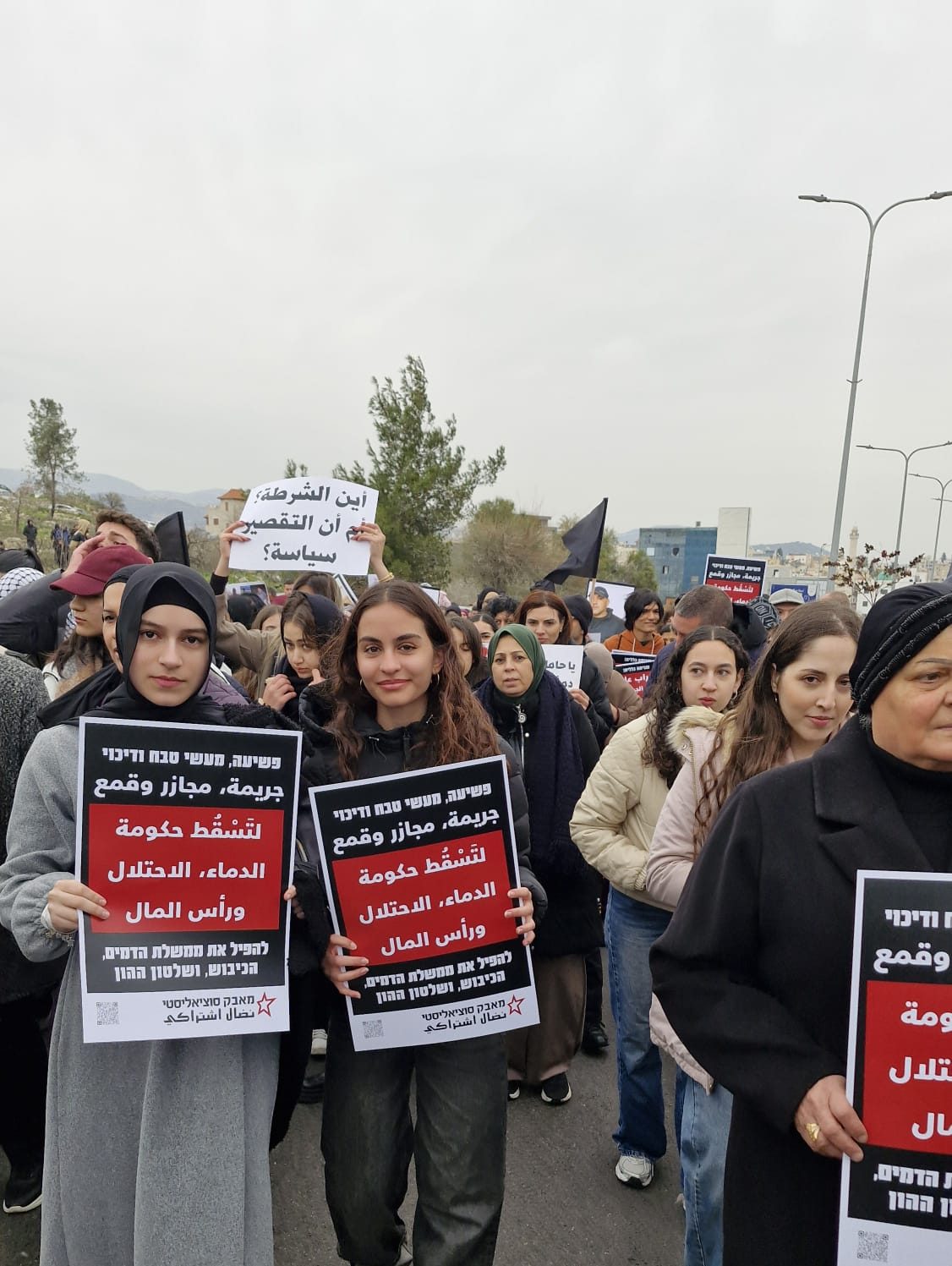
On the local level, references to the Popular Front in Spain arise in discussions on strategy for the struggle against the Israeli far right and against the aggression of Netanyahu’s capitalist government of death, against the backdrop of the ongoing war crisis, the war of annihilation in Gaza, the deepening of the occupation, and the expansion of Kahanist-fascist settler terror. In Al-Jabha/Ḥadash, for example, they return to this experience in discussions on the role of the left and the Joint List ahead of the upcoming elections.
However, the balance sheet of the historical experience demonstrates that the desire, justified in itself, for a powerful and broad struggle that succeeds in uniting mass layers against the far right is not enough.
International Solidarity
The dramatic upheavals in Spain in 1936 drew global attention. Shortly after the formation of the Popular Front government, General Franco’s fascist coup began, marking the start of the Civil War, which was met with a mass uprising. In retrospect, the Civil War was perceived as the ‘dress rehearsal’ for the Second World War. But in real time, the masses around the world saw the anti-fascist struggle in Spain as the last chance to halt the descent into global war and to inflict a defeat not only on Franco’s Falanges, but also on his allies in the form of the fascist regimes in Italy and Germany. Spain — alongside France — became a key arena in the struggle against the rise of fascism. And in fact, a decisive arena in the clash between the forces of revolution and counter-revolution on a regional and even global scale.
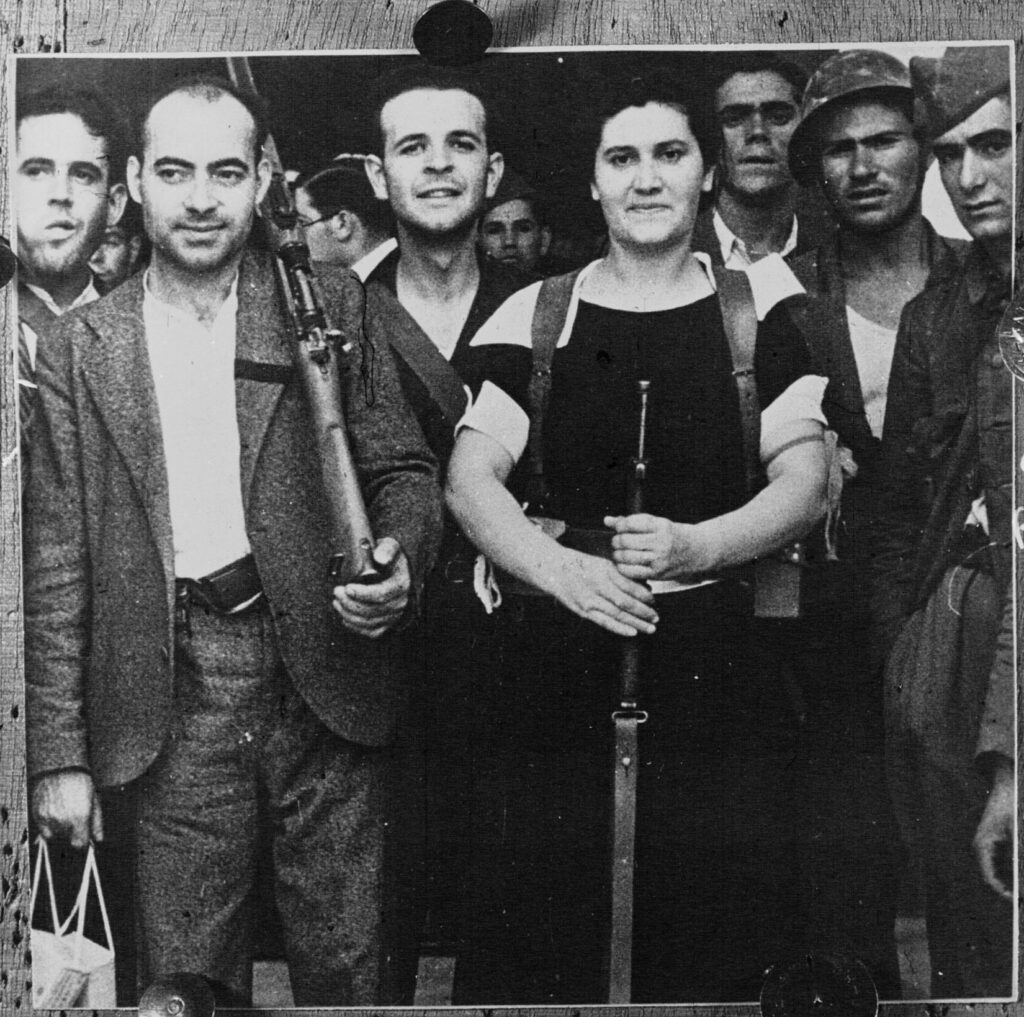
Tens of thousands of workers from all over the world volunteered to travel to Spain and take up arms to halt the fascist forces. The mobilisation was organised within the framework of the Comintern’s International Brigades (the ‘Communist International’, then controlled by the Stalinist USSR), and within the militias of the anarchists and those of the POUM. The women who volunteered insisted on doing so even in the face of harsher acceptance conditions due to gender-based discrimination and prejudice.
Most volunteers came from France or from among exiles fleeing the fascist regimes in Germany and Italy. It is also worth noting the presence of volunteers from the USA and Latin American countries, and especially from North Africa and the Middle East. This included fighters from ‘Mandatory’ Palestine — Arabs and Jews, mostly members of the Palestinian Communist Party (PCP).
In contrast, the Zionist parties of the time, including those trying to present themselves as ‘socialist’, opposed sending volunteers. It was Yaʿakov Ḥazan, a leader of the HaShomer HaTzaʿir movement, who coined the slogan ‘Ḥanita before Madrid’ (Ḥanita refers to a Zionist settlement outpost that was established during that period in the northern Galilee).[1] Yet according to various estimates, 150–300 young Jewish men and women joined the International Brigades,[2] defying Zionist nationalist propaganda that called for their mobilisation for the purposes of the settlement project and national dispossession, and for the suppression of the Great Arab Revolt that also broke out in 1936.
The local mobilisation was, as mentioned, cross-national. One of the more well-known Palestinian volunteers in the Brigades was the communist Muḥammad Najati Ṣidqi. He confronted right-wing voices among the local Arab elite who called for supporting Franco’s phalanxes — which recruited, among others, in Morocco from the population subjugated under Spanish colonialism — allegedly as a move against British imperialism, which was supposedly on the side of the Republican government in Spain. The British Mandate authorities, which violently suppressed the Great Arab Revolt, persecuted and imprisoned Ṣidqi for a period of two years, but he opposed the logic that ‘the enemy of my enemy is my partner’.
In one of his articles, published during the Spanish Civil War in the socialist newspaper The Vanguard (الطليعة) printed in Beirut, Ṣidqi wrote:
‘I was an Arab volunteer that had come to defend the Arabs’ freedom on the front in Madrid. I had come to defend Damascus in Guadalajara, Jerusalem in Cordoba, Baghdad in Toledo, Cairo in Andalusia.’[3]
Although the Communist parties of the time, under the direction of the Kremlin, turned to emphasising a national-democratic agenda at the expense of class internationalism and socialism, Ṣidqi actually expressed an appeal to the masses in the Middle East to support the revolution in Spain out of an understanding that its success would give a tremendous impetus to anti-colonial movements — and that the liberation of the Arab nation from the yoke of imperialism and the social liberation of the masses in the region are fundamentally part of a global struggle.
However, Ṣidqi’s efforts were not suitable with the policy of the Republican government in Madrid, which refused to recognise the right to self-determination for Morocco and denied even the possibility of autonomy. This stemmed from its aspirations to appease French and British imperialism, which were then facing rebellions in regions under their control in North Africa. Despite this, the capitalist classes in France and Britain preferred to continue a policy of ‘non-intervention’ while the Italian and German fascist regimes intervened militarily with full force, including horrific bombings of population centres. The bombing of the town of Guernica by the Nazi German air force was immortalised in Picasso’s timeless painting.

Elections, Coup, Revolution… and Repression
Although it was not the intention of its leaders, the coming to power of the Popular Front government in the democratic elections of February 1936 opened a new chapter in the revolutionary struggle of the working class and the peasantry, as well as of the feminist movement, the oppressed nationalities within the Spanish state, and the masses subjugated under Spanish colonialism in North Africa. A wave of workers’ strikes and struggles by landless peasants erupted immediately after the elections, and far-right elements were forcefully driven from the streets, out of a mass understanding that the far right cannot be obstructed solely through the ballot box, and that the rule of capital will not volunteer concessions and rights without a struggle.
Within five months, in July, the fascist coup led by Franco began, receiving support from the overwhelming majority of the capitalist class in Spain, the large landowners, and the heads of the Church. Although the coup was organised in response to the rise of the Republican government, in essence, it was directed against the growing power of the working class in Spain and against its aspirations for a revolutionary socialist transformation. In practice, the government’s policies — which did not challenge the rule of capital and not even the power of the Church and the senior officer corps — did not inherently constitute a danger from the perspective of the ruling class.
The fascist coup was met, as mentioned, with a mass revolutionary uprising on 19 July. In Barcelona, the official unions and workers’ organisations, alongside spontaneous workers’ formations and militias established in the heat of the events, practically began to seize power from the ruling class.
The leaders of the parties participating in the Popular Front government opposed the development of the seizure of government buildings, military bases, and most importantly, the land and factories, by peasant and workers’ organisations, alongside the mass arming. The mass anti-fascist struggle, which developed into a revolutionary process against the rule of capital in society, went much further than the limited programme of change that those leaders had drafted while insisting on maintaining capitalist property relations. They had agreed in advance that the demand for the expropriation and transfer of banks, large corporations, and land to public ownership and democratic workers’ control would be rejected outright. When the masses stormed to expropriate control over these social assets — many of which were anyway owned by capitalists who had supported the fascists and fled the country — the ministers of the Popular Front government not only tried to block initiatives from below, but resorted to force to thwart them on the pretext that ensuring a military victory over Franco required maintaining ‘order’ on the Republican side.
The revolutionary masses in Spain very quickly faced a dual task: repelling the military assault of the fascist counter-revolution, and simultaneously blocking the attempts of the Republican government to intervene to save the social order that had spawned fascism — the capitalist order of exploitation, poverty, and political oppression.
In terms of the fundamental policy practically advanced, the Republican government was not on the side of the masses. It was a pro-capitalist government, despite the fact that the official leaderships of the workers’ movement in Spain participated in it, including its parties — the Stalinists, the Social Democrats, but also the POUM and the anarchists. In the name of ‘unity against fascism’, the leaders of those parties found themselves in varying degrees of collaboration with repressive measures taken by the capitalist Republican government against the most revolutionary layers of the working class, whom they claimed to represent.
The ‘Communist Party’, under direct orders from the Kremlin, led the most hawkish line against the left opposition that had developed within the working class. At a certain stage, Stalin conditioned all military and economic aid from the USSR on the suppression of the socialist opposition.
The actions of the Republican government, under the guise of acquiring arms and international support to ensure military victory against fascism, undermined the workers’ ability to do exactly that — to defeat General Franco’s coup and fracture its social base of support, especially among sections of the poor peasantry, which hungered for social reforms.
Unity in the Anti-Fascist Struggle
Following Hitler’s rise to power in 1933, the working masses in Spain clearly understood the need for a united front of their organisations against the threat of fascist counter-revolution — which was identified in Spain at that stage mainly with CEDA and Gil Robles. Such unity found expression in the Workers’ Alliance (Alianza Obrera). This organisation was formed in 1934 in defiance of the accommodating reformism of the leaders of the ‘Spanish Socialist Workers’ Party’ (PSOE), the refusal of the leaders of the anarcho-syndicalist movement and the CNT (National Confederation of Labour) to intervene in the political struggle, and the approach of the leaders of the ‘Spanish Communist Party’ (PCE), who until then argued that there was no difference between fascist forces and other right-wing forces, nor even social-democratic forces. The establishment of the Workers’ Alliance was a step forward for the class struggle, although not without its limitations, paving the way for the Asturian miners’ uprising that year, and for a series of strikes and mass actions that smashed Robles’s movement.
However, the Popular Front of 1936 was not a continuation of the Workers’ Alliance of 1934. It represented a break from the idea of the united front of the workers’ movement, replacing it with an alliance with the parties of the liberal republican bourgeoisie, in the form of Manuel Azaña’s Republican Left. The joining of working-class unions and parties into a joint political bloc with capitalist parties dictated a ‘common’ platform, which restricted the actions of the workers’ movement to what was acceptable from the standpoint of the owners of capital and their lackeys.
The formation of the Popular Front in Spain was directly linked to the Stalinist political counter-revolution in the USSR, which also led to the complete Stalinisation of the Comintern. Under Stalin — after he had sabotaged the struggle against the rise of the Nazis in Germany — the Comintern aggressively pushed, from 1935 onwards, for the establishment of a Popular Front with the ‘democratic’ bourgeoisie. This was not in spite of the limitations such a front imposed on the workers’ movement and on the struggle for socialism, but precisely because of them. At that time, the interest of the totalitarian bureaucratic caste represented by Stalin was to portray themselves as reliable partners for French and British imperialism, by removing the horizon of socialist revolution from the agenda of the ‘Communist Parties’ that were under his tight control — in France, in Spain, and everywhere else.
Kasper Braskén, in an article published this year in the magazine Jacobin to mark 90 years since the Popular Front government in Spain,[4] which presents a common view in social-democratic circles, polemicises with ‘the Comintern’s far-left critics, including Trotskyists’, who ‘interpreted the Popular Front as a devastating betrayal of revolutionary politics’. In the same article, Braskén admits that ‘In all cases, the Popular Front emerged as a balancing act to harmonize the interests of labor and capital’.
In reality, the fundamentally opposed interests of labour and capital — of the exploited class and the exploiting class — could not be balanced or harmonised in times of peace, and certainly not in times of crisis, war, and revolution. Subordinating the working class to the interests of capital by negating the most basic demands of the workers is indeed fundamentally a ‘devastating betrayal’, exacting heavy prices, including in human lives.
The workers’ movement was forced to ‘put aside’ until an unknown future its demands for increased unemployment benefits, for the redistribution of land from the tycoons to the landless peasants, and the expropriation of resources from the capitalists, including control over the banks, during a worsening international and local capitalist crisis. The cost of the crisis was rolled onto the shoulders of the workers and the poorest layers of the peasantry, who even suffered from starvation. The consequences only strengthened the basis for the populist appeal of fascists to those layers with the slogan ‘What has the Republic given you to eat?’ — and with a promise to extricate them from the crisis.
As part of examining the lessons of the Spanish Revolution, it is necessary to examine the social-class character of the Popular Front coalition, and its role in the context of a fundamental social crisis, and a process of social revolution and counter-revolution that unfolded in Spain and beyond. In practice, the Popular Front in Spain was utilised to compel the workers’ movement to abandon, in the name of ‘unity against fascism’, its fundamental and urgent political demands at the time in favour of maintaining the alliance with capitalist forces. And this concession had catastrophic consequences, paving the way for the victory of the fascist counter-revolution in Spain and for a dictatorial regime that lasted until General Franco’s death in 1975.
To pull the political center to the left?
Braskén argues that ‘Perhaps unjustly, the Popular Front today is primarily remembered as a defence mechanism against fascism and the far right, but it should equally be seen as a powerful means to pull the political center to the left’. The truth is that this same front was a means to pull the workers’ parties to the right, which also turned it into a failed defence mechanism against fascism.
‘[T]he worst and most reactionary form of utopianism is the idea that it is possible to struggle against fascism without overthrowing the capitalist economy’ — this is how Leon Trotsky, one of the leaders of the original socialist revolution in Russia and the founder of the Fourth International (those whom Braskén calls ‘Trotskyists’), summed up the experience of the Popular Front in Spain. Trotsky closely followed the Spanish Revolution and Civil War, debating their course with leaders of the workers’ movement in Spain and internationally, analysing them in numerous writings. He treated the dramatic events as a political test for ideas and political forces, and leaders, far beyond the borders of Spain.
This is a historical debate that remains relevant. The current proponents of the historical Popular Front of Spain, particularly from among ‘Communist’ parties that continue certain aspects of the Stalinist political legacy, use the historical example to promote a long-term political alliance between left-wing forces and capitalist parties from the ‘centre’, as a response to the threat posed by far-right and populist right-wing forces.
A local example of this can be found, for instance, in the reference by former MK Dov Khenin in an article he published in 2017, during the early consolidation period of the Standing Together movement:
‘Coping with the dangers must be aided by the experience of the past. The 1930s were not only a period of the rise of fascism, but also the days of the Popular Front — an inspiring stand against it… To understand it, we must address both words. The word Front expresses a broad partnership between liberals, socialists, and communists, which was created in the 1930s in France and Spain, and later translated into an anti-Nazi alliance of states in the Second World War. The word Popular dictates that an alliance of elites will not succeed against fascism, but rather what is needed is a front that speaks to the people and from within the people, and expresses the popular distresses, angers, and desires — instead of these being appropriated and hijacked by the right.’[5]
Albeit, the Popular Front was not an ‘alliance of elites’, it was an alliance with the elites, led by the elites, for the preservation of the interests of the elites. This fact found expression from the very stage of the ‘common’ platform. While the Popular Front election platform — agreed upon and signed by all the workers’ parties, including the POUM — promised to release the masses of political prisoners who had led the 1934 uprising in Asturias and across Spain, it openly rejected all the other key demands of the workers’ movement:
‘The republicans do not accept the principle of the nationalisation of the land and its free distribution to the peasants […] The republicans do not accept the unemployment benefits requested by the workers’ representatives […] The republican parties do not accept the measures for the nationalisation of the banks proposed by the workers’ parties […] The republican parties do not accept workers’ control.’[6]
The rejection of those demands was consistent and continued throughout the days of the Popular Front until its surrender to Franco.
From a relatively early stage, the Popular Front government ceased to credibly express ‘the popular distresses, angers, and desires’, as it was exposed as an obstacle to comprehensive social reforms, and certainly to a full socialist programme that would offer fundamental solutions to the crisis. Franco’s forces relied on and exploited the decline in public trust in the Republican government, and in the morale and self-confidence among the masses of the working class and particularly the peasantry.
In December 1937, in an article titled ‘The Lessons of Spain — The Last Warning’, Trotsky explained that:
In Spain, ‘there was no lack of heroism on the part of the masses or courage on the part of individual revolutionists. But the masses were left to their own resources while the revolutionists remained disunited, without a program, without a plan of action. The “republican” military commanders were more concerned with crushing the social revolution than with scoring military victories. The soldiers lost confidence in their commanders, the masses in the government; the peasants stepped aside; the workers became exhausted; defeat followed defeat; demoralization grew apace. All this was not difficult to foresee from the beginning of the civil war. By setting itself the task of rescuing the capitalist regime, the Popular Front doomed itself to military defeat.’[7]
Historical Lessons
Khenin, in a lecture he presented in 2011 entitled ‘Learning from Experience: Coverage of Resistance to Fascism in World History’[8], claimed that ‘a popular front can succeed’ and that ‘Spain was a success’. He tried to reconcile the contradiction between the claim of ‘success’ and the catastrophe of the victory of fascism thus: ‘It is true that afterwards there was a civil war, in which there was foreign intervention by Italy and Germany and a policy of non-intervention by the Western countries, which allowed this regime to be drowned in blood, but the Popular Front in Spain succeeded.’
Trotsky at the time replied to such logic:
‘It is simply ridiculous to justify the defeat by references to the military intervention of Italian fascists and German Nazis, and to the perfidious conduct of the French and British “democracies”. Enemies will always remain enemies. Reaction will always intervene whenever it can. Imperialist “democracy” will always betray. This means that the victory of the proletariat is impossible in general! But what about the victory of fascism in Italy and Germany itself? No intervention there. Instead we had there a powerful proletariat and a very large Socialist Party and, in the case of Germany, a large Communist Party as well. Why then was there no victory gained over fascism? Precisely because the leading parties tried to reduce the question in both these countries to a struggle “against fascism” when only a socialist revolution can defeat fascism.’[9]
In this context, Trotsky also addressed the arguments — heard in the aforementioned lecture — that during the struggle against the danger of fascism there was no room for a ‘purist’ approach towards an alliance with the republican bourgeoisie:
‘All our forces must be centered on this immediate goal, etc., etc. Of course, of course! But tell us, pray, why during a struggle against fascism must the land belong to the landlords and the factories and mills to the capitalists, all of whom are in Franco’s camp? Is it perhaps because the peasants and workers “have not matured” for the seizure of land and factories? But they proved their maturity by seizing on their own initiative the lands and factories. Reactionaries, who call themselves republicans, under the leadership of the Stalinists, were able to smash this powerful movement allegedly in the name of “anti-fascism”, but in reality in the interest of bourgeois proprietors.’[10]
The claim that the Popular Front social coalition was successful in the struggle against fascism is historically unfounded. It is liable to lead to political short-sightedness and erroneous conclusions also regarding the challenges in the current struggle against the threats of the far right.
At the current stage, although generally there are no mass parties of struggle based in the working class, an overly abstract approach to the question of political ‘partnership’ in the struggle against far-right threats can be dangerous. The questions of which forces align with one another, on what basis, and around which political programme and what course of action — remain fundamental. The logic of the Popular Front is applied in a variety of cases both regarding the idea of establishing a ‘left-wing government’, and in relation to more limited political coalitions.
Under the State of Israel, for example, the socialist left must warn against ‘democratic’ political alliances with right-wing, pro-occupation, and pro-capitalist forces that justified and spurred on the war of annihilation in Gaza, such as Bennett, Lapid, and General Golan, who portray themselves as ‘liberals’ and ‘democrats’ in their eyes. Similarly, a distinction must be made between ad-hoc tactical cooperation, even with liberal forces, in order to block specific legislation or attacks, and broad political coalitions and long-term electoral alliances around a ‘common’ platform with capitalist political forces. Those who currently refer to the historical Popular Front as a successful model are promoting the concept of a common platform, which means joining together to advance a supposedly softened version of a nationalist capitalist agenda, which will pave the way for further severe crises, instead of advancing a substantive political alternative that promotes a struggle around a fundamental exit strategy from a systemic crisis.
Memory is Political
There is no doubt that on the 90th anniversary of the Spanish Revolution, socialists will cherish the heroism of the masses and the courage of individual revolutionaries. We will remember the tens of thousands of workers and peasants who sacrificed their lives in the revolutionary struggle for liberation and socialism. We will remember the rank-and-file comrades in the UGT, the CNT, and the POUM, who, despite the grave errors and betrayal by their leaders, continued to fight to the end — some falling in battle or in Franco’s prisons, and others assassinated by Stalin’s agents.
But memory must be political. It must serve as a pathway for learning the central lessons of the Spanish Revolution. Above all, the revolution demonstrated tragically that the vital determination expressed in the slogan ‘Fascism shall not pass’ is not enough in itself. Equally important is the insistence on ideological clarity and on principles in the struggle, including in the face of pressures to ‘fall in line’ with liberal forces, to ‘downplay’ socialist demands, and to ‘postpone to a later stage’ the struggle for socialism because of the ‘gravity of the hour’ and the ‘looming threat’.
A political alliance against the far right that places pro-capitalist elements and their political programme at the helm, and turns the socialist left into the tail end and the ‘working hands’ on the ground while the elites make the decisions, is liable to lead precisely to the strengthening of populist right-wing and far-right forces that will continue to masquerade as an alternative to establishment parties and ride on mass distress and societal antagonism toward representatives of the elites.
The Spanish Revolution demonstrated, albeit in a negative way, the need not for a ‘New Popular Front’, but for a persistent and unapologetic socialist left. A socialist left that knows how to lead with the necessary political programme also collaborations and principledly harnessing liberal elements in order to strike a blow against the far right, without letting it be forgotten that the crisis of capitalism and the failure of liberal politics are the cause and context for its growth.
[1] Raanan Rein, Cathedra 179, September 2021, pp. 135–156.
[2] Brodkin, Yedioth Ahronoth, October 1972, p. 14.
[3] Memoirs of a Palestinian Communist in the Spanish International Brigades, Jerusalem Quarterly Issue 62, 2015.
[4] Kasper Braskén, The Promise and Tragedy of the Popular Front, Jacobin, 23.02.2026.
[5] Dov Khenin, The Left Must Go on the Offensive, Haaretz, 13.02.2017.
[6] Manifiesto del Frente Popular, El Socialista, 16 January 1936.
[7] Leon Trotsky, The Lessons of Spain — The Last Warning, December 1937.
[8] Dov Khenin, Learning from Experience: Coverage of Resistance to Fascism in World History, 26.01.2011.
[9] Leon Trotsky, On the Causes for the Defeat of the Spanish Revolution, March 1939.
[10] Trotsky, 1939, Ibid.