One of the most notable “achievements” of Netanyahu’s murderous capitalist government and the far right has been the dramatic expansion of settler terrorism, particularly since October 7, 2023. The government cynically exploited the attacks not only to launch a war of extermination against the Palestinians in Gaza, but also to wage a sweeping campaign of ‘occupation, expulsion, and settlement’ throughout the West Bank.
During the government’s term, the spread of Kahanist terrorist organisations in the West Bank reached a new peak with the establishment of around 250 new outposts. The total number of outposts has more than doubled. But establishing them is not an end in itself. They are a means of advancing land seizures and ethnic cleansing. Settler militias organise in these outposts to attack residents, damage property and livestock, and block access to infrastructure and water sources. According to a new report by B’Tselem, ‘as of July 2026, Israel had used these militias to take control of more than 1,070,000 dunams, amounting to 18% of the West Bank.’
This takeover has been accompanied by displacement. Between 2023 and 2025, 118 Palestinian communities and shepherding hamlets were driven from their land. This is the result of a well-organised campaign of terror that enjoys direct government support.
Most recently, on September 23, government ministers Bezalel Smotrich, Yariv Levin, Nir Barkat, and Shlomo Karhi participated in a ceremony marking the establishment of the Matzukei Eretz settlement, which in practice amounts to the retroactive authorisation of the Netzaḥ Harel Farm colonial outpost. The outpost was established in 2023 next to the Palestinian community of al-Muʿarrajat and brought about the community’s displacement in December of that year.
Smotrich used the ceremony to boast of an‘unprecedented construction boom in Judea and Samaria’ and of laying the groundwork for ‘one million settlers’. Yet according to the Tamrur–Politography research group, ‘over the past 20 years, the overall migration balance of the settlements has gradually declined, and under the current government it has turned negative, with more people leaving than arriving.’
Most of the Israeli public does not regard the settlements as an “asset”, and there are no million Israelis waiting to move there. For the government, however, the colonial settlements, and especially the farm outposts, serve as forward positions in the drive to annex the West Bank. The government therefore does not limit itself to retroactively authorising outposts. It also provides them in advance with material support, weapons, equipment, vehicles, and all-terrain utility vehicles that facilitate the violent seizure of land in the surrounding area. Without government backing, the wave of settler terrorism could never have grown to its present, horrifying proportions.
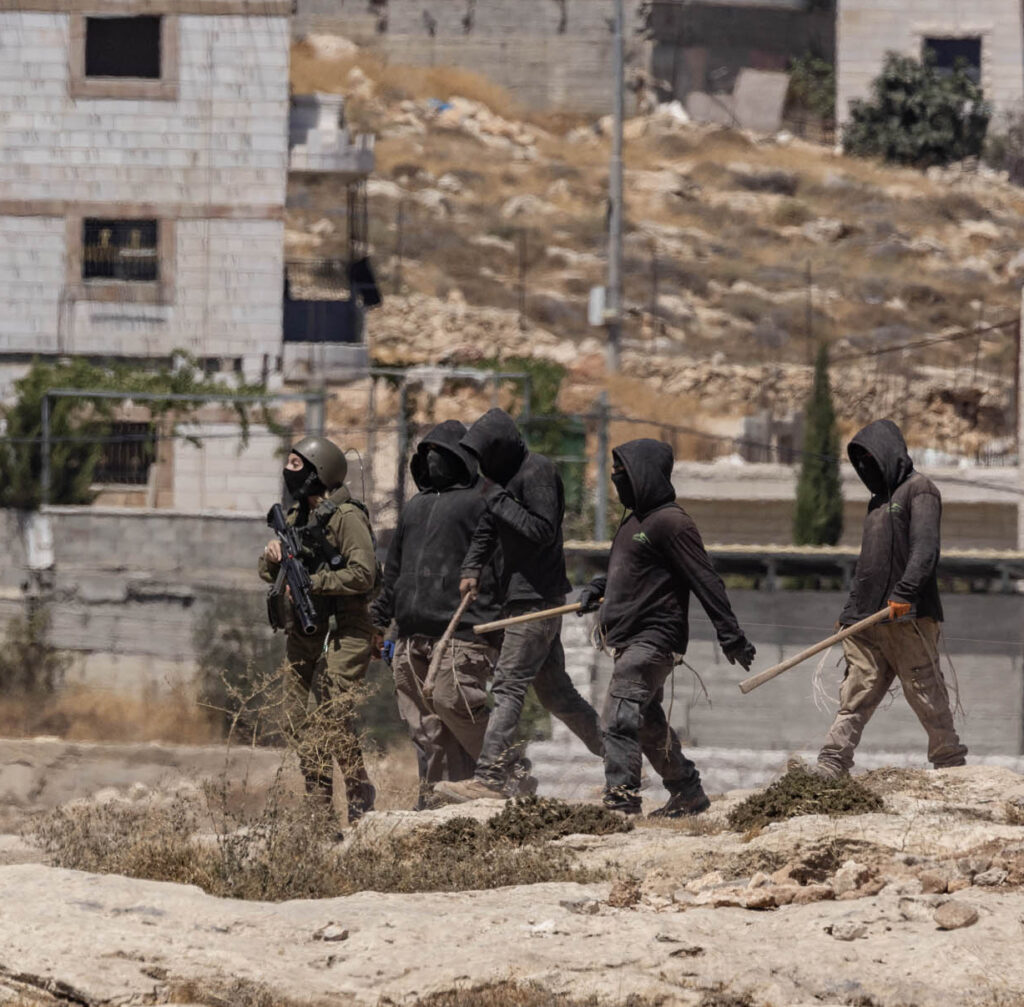
Far-right gangs operate under the cover of settlement emergency security squads. Alongside them operate military security coordinators, police units, and, of course, army forces. These forces do not merely “stand by” while the gangs carry out pogroms. In many cases, they actively participate by firing tear gas and even live ammunition at Palestinian residents attempting to defend themselves.
Since October 2023, the army has recruited thousands of settlers to serve near their own communities as part of regional defense battalions, while thousands more have been incorporated into emergency security squads in settlements and outposts. On the ground, the distinction between settler terrorism and the state terror inflicted on Palestinian residents by the military and other state authorities is becoming increasingly blurred.
Netanyahu’s Speech of Lies
Despite the increasingly blurred distinction between settler terror gangs and the state’s official forces, the government sometimes finds it convenient to deny any connection to them. That is what Benjamin Netanyahu did in his latest speech at the United Nations. Settler terrorism? According to Netanyahu, ‘What they [the media] cover is a handful of juvenile delinquents, about 150 in number, who throw stones, who chop down olive trees, occasionally they lite some fires. I can’t stand that. I won’t stand for vigilantism. We’re a country of law. So we put our Shin Bet on them. But that’s what they call settler violence. And the number of casualties a year? Maybe two or three.’
What is the real number of casualties? According to figures from OCHA, between the beginning of 2023 and May 2026, settler gangs in the West Bank carried out more than 5,300 attacks that left 64 Palestinians dead, as well as many others wounded, livestock stolen, and infrastructure, property, and livelihoods damaged. But Netanyahu is lying not only about the number of victims and the scale of the phenomenon, but also about the enforcement measures supposedly taken against it.
According to data published by Yesh Din, 93.6% of the investigation files opened between 2005 and 2025 over settler violence against Palestinians ended without an indictment, while only 3% resulted in a full or partial conviction. These figures make clear that the settler terror gangs operate within a nearly absolute sphere of impunity.
The central fact that Netanyahu is trying to conceal is that settler terrorism is yet another instrument in his government’s toolbox for advancing the creeping annexation of Area C, which comprises around 60% of the West Bank. Over the past two years, this unofficial arm has operated with growing frequency in Area B as well, which accounts for approximately 22% of the West Bank, uprooting Palestinian communities and transferring them into densely packed enclaves in Area A, which comprises about 18% of the territory.
In 2026, nearly two-thirds, 62.6%, of the violent incidents against Palestinians documented by Yesh Din took place in Areas A or B.
This process largely overlaps with Bezalel Smotrich’s 2015 “Decisive Plan” Although the plan was never formally adopted, arms of the state are implementing parts of it on the ground. The army and the Civil Administration are uprooting Palestinian communities in Area C. In addition, during 2025, the army carried out the most extensive displacement operation since 1967, uprooting close to 40,000 residents from the refugee camps in Jenin, Tulkarm, and Nur Shams in Area A. Every arm of the occupation regime is working to force the Palestinian population into a handful of enclaves cut off from one another.
These measures also have supporters in the chauvinist “change bloc”. It is no coincidence that Gadi Eisenkot’s election tour of the West Bank, conducted alongside settler leaders Yossi Dagan and Davidi Ben Zion, included a visit and strategic briefing at the Shuvael Farm outpost. Established in October 2024, the outpost brought about the expulsion, within a month, of the Farʿata community located to its south. This is the strategy.
Avigdor Lieberman, chair of Yisrael Beiteinu, recently wrote that ‘the State of Israel must create territorial continuity between all parts of Area C and maintain absolute control there. At the same time, an alternative must be found to administrative and security control over Areas A and B.’ He added that, in his view, ‘an agreement must be reached with Jordan under which it would administer Areas A and B, within an Israeli–Jordanian confederation.’
What Is the Dispute Between the Military High Command and the Government About?
Why, then, has a dispute erupted between the military high command and the government over settler terrorism? There are several interrelated reasons: concern about the erosion of the authority of the military establishment and its ability to control the intensity of the conflict in the West Bank, particularly in the event of a multi-front war; concern about shifts in international, regional, and domestic public opinion, which in turn affect Israel’s foreign relations; and the Israeli military establishment’s fear of Palestinian initiatives for self-defence and of organised, broader resistance to aggression by the settlers and the army.
These concerns are of no interest whatsoever to the leadership of the so-called “Hilltop Youth”, which seeks to take the dispossessing logic of the Zionist movement to its ultimate conclusion, here and now. That leadership is willing to accept, and even demand, any assistance offered by the state and the army, but it is unwilling to obey their orders or submit to their authority. In the eyes of the leaders of the settler terror cells, the Israeli army is controlled by “weak” elements that refuse to wage a war of extermination in the West Bank along the lines of the genocidal crimes committed in Gaza. Therefore, they see no reason to obey them. This position has been reinforced by the “judicial coup” project, the far-right ministers, and, since he entered office, War Minister Israel Katz.
Upon taking office, Katz abolished the use of administrative detention orders against Jewish settlers suspected of terrorism, while continuing the extensive use of administrative detention against Palestinian residents for every form of resistance to the occupation, acts of self-defense, and even the documentation of settler attacks.
Recently, Katz attempted to remove General Avi Bluth, the head of Central Command who brutally enforces the occupation in the West Bank, over his tactical support for a restraining order against settler terrorist Tal Yinon Dardik. The order followed Dardik’s involvement in a particularly horrific pogrom in Khirbet Humsa in March. Katz, and in practice the government as a whole, is backing Dardik against the army’s representative. The expungement of the criminal conviction of the executioner-soldier Azaria by President Isaac Herzog, contrary to the military high command’s official position, further reinforces this trend.
The denunciations of settler terrorism by former chief of staff Gadi Eisenkot and former deputy chief of staff Yair Golan, along with their criticism of the absence of enforcement, flow directly from the concerns of the generals and of Israel’s ruling capitalist elite. They are demanding action against the most violent gangs and outposts, particularly as they watch the widespread revulsion around the world at the daily acts of terror committed by Kahanist gangs find expression in the mainly symbolic measures that Western governments are being compelled to take against the settlements. This month, on September 8, Britain, France, and Canada, together with nine other European Union countries, announced a boycott of settlement products.
Within Israeli society, too, the images of motorised pogroms, of armed and masked gangs making their way into Palestinian communities in white pickup trucks, are provoking unease, criticism, and resistance. Broad layers of Israeli society are repulsed by settler terrorism, despite their support for Israeli military aggression in the West Bank, Gaza, and the wider region. Polls by the Israel Democracy Institute, as well as other surveys conducted by aChord Center and Tamrur Politography, indicate that a majority, including among Israel’s Jewish population, believes that the state authorities are not doing enough to combat settler terrorism.
Faced with this, the chauvinist “change bloc” aims to restore legitimacy to the colonial settlement project and the occupation regime, both internationally and domestically, by promising to “deal with” settler terrorism and the outposts. ‘Precisely as someone who believes in our right to the land and in the settlement enterprise, we must denounce the rioters and eradicate all violence from within our ranks’, wrote Naftali Bennett. General Golan’s line is not fundamentally different: ‘When we replace them [the Netanyahu government], Jewish terrorism will be eradicated, Ben-Gvir’s armed militias will be dismantled, Smotrich’s illegal outposts will be removed, and the IDF will return to defending Israel’s security.’ In other words, it will continue the occupation of the West Bank and continue undermining the welfare and security of millions of Palestinian residents, under the fraudulent guise of promoting security for millions of Israelis.
The Siege of Qusra
The siege of Quṣra is a case in point. For reasons of public image and international relations, the army chose to cooperate with the performance staged by the US ambassador to Israel, Mike Huckabee, and his announcement that, ‘the IDF & Israel Police have gone at our request to remove the Israeli terrorists’ from the community in mid-August. Huckabee, an enthusiastic supporter of the settlement project and the annexation of the West Bank, demanded the removal of the outpost from Quṣra precisely in order to restore legitimacy to the continued occupation.
But the performance quickly came to an end. Over the past month, the army has continued to impose a siege on the Palestinian residents of the community, barring journalists and solidarity delegations from entering while turning a blind eye to the permanent presence of settler gangs.
A delegation from SSM arrived in Quṣra in early September as part of an organised solidarity action with the residents living under military siege. Although the army blocked the delegation, it nevertheless succeeded in conducting interviews on the ground.
‘The settlers are on the hill, and the army is also on the hill. As you can see, many soldiers arrived here within ten minutes. Those soldiers could have removed the settlers from the hill, and that would have brought the siege to an end’, explained ʿAbd al-ʿAzim al-Wadi, the mayor of Quṣra, in an interview with us.
Luay Beiruti, a resident of Quṣra, also described the situation in an interview. He explained what happened when the army arrived at the house he was building in the community while settlers were laying siege to it: ‘They [the settlers] kept us under siege inside the house for about three hours. Then the army arrived, and the army tightened the siege around us even further. They fired tear gas at us and kept us trapped inside the house. Then they arrested us and dumped us in the village of Duma.’
So What Is Needed to Stop Settler Terrorism in the West Bank?
The role of the military occupation forces in the West Bank has never been to protect the Palestinian population. So who will defend them against settler terrorism? Palestinian residents have not hesitated to answer that question. Despite severe repression, recent years have seen a series of initiatives to establish patrol, rapid-response, and neighbourhood watch committees in dozens of localities and communities across the West Bank.
In some localities, self-defence efforts have emerged more spontaneously, as an immediate response to needs on the ground. Neighbours summon one another to help confront attackers through what is sometimes called fazʿa, or collective mobilisation, in keeping with a tradition rooted in the Palestinian struggle for national liberation. But as attacks by settler gangs have become more organised and lethal, and as their frequency in some areas has risen from several incidents a month to daily pogroms, self-defence efforts have also become more organised.
According to a report by Yaniv Kubovich in Haaretz, based on sources in the Israeli military, ‘around 70 neighbourhood watch committees, similar to emergency security squads, have been established in the Palestinian Authority to protect residents from the violence.’ Those military sources clearly regard this as a negative development. From the standpoint of the struggle against settler terrorism and the occupation, however, and from the standpoint of the genuine interests of working people, including in Israel, it is necessary and vital.
‘We have been left alone. You are facing settlers who receive support from their government, and we have no one. So we are forced to remain here and defend this town’, Fadi ʿAlwan, a volunteer with the neighbourhood watch committee established in Sinjil, told Reuters.
The committee’s activities include lighting a fire at night, scanning the surrounding hills with searchlights for settler gangs, conducting vehicle patrols around the town, and operating community WhatsApp groups through which residents can warn one another of potential attacks.
‘If they approach the houses, we go to confront them, and we send messages through the WhatsApp groups’, ʿAlwan explained. ‘Since we began maintaining a presence here [at night], the attacks have fallen by around 90%, because we started spotting them.’
‘Since the beginning of last year, and as a result of the escalation of the attacks on Sinjil… we have had to organise the guard duty more effectively and move from a model of fazʿa to a more organised system’, one resident explained in an interview with Majd Jawad, a journalist from Jenin.
‘As soon as we spot the attacking settlers, we notify the residents via WhatsApp or walkie-talkies… We do not possess tools or weapons comparable to what the settlers have. Instead, we ensure our bodies are always present in areas likely to be targeted, to deter an attack before it even begins.’
This tradition of organisation also draws inspiration from the popular committees established during the First Intifada. At that time, the committees enabled residents both to organise everyday life in their communities during the mass uprising, which was met with closures, restrictions on movement, and severe repression, and to coordinate actions and lead the struggle to overthrow the occupation and achieve national and social liberation.
Today, similarly, the army and every arm of the Israeli establishment are working to dismantle and fragment any organisation by Palestinian residents against the occupation. The army tears down watch tents, confiscates equipment, and even fires live ammunition at unarmed patrols. These measures are accompanied by mass arrests, the use of administrative detention against key organisers, and collective punishment against entire communities.
Settler terror gangs form part of an entire system, and the struggle against them must likewise form part of a broader campaign. Local neighbourhood watch committees and residents’ self-defence efforts in individual communities will become more effective if democratically controlled organisation, involving broad layers of the population, is integrated into coordinated collective action throughout the West Bank and beyond.
This means linking these initiatives with popular committees, workers’ organisations, and student associations in major Palestinian urban centres such as Nablus and Ramallah, as well as in East Jerusalem. The West Bank’s Popular Struggle Coordination Committee has worked in this direction, including by successfully mobilising students from Birzeit University for solidarity actions with threatened agricultural communities across the West Bank.
One factor that currently makes it more difficult to connect the various local watch and defence initiatives into a generalised uprising against the occupation regime, along the lines of the First Intifada, is the absence of a political leadership and the weakness of the left both in the territories of ’48 and those of ’67. In the West Bank, this weakening has also resulted from the depoliticisation and “NGO-isation” of social movements and popular struggles, meaning the transformation of social struggles and fighting organisations into nongovernmental organisations.
The Palestinian Authority has played a decisive role in the degeneration of some of these organisations by integrating them into structures that neutralised them. This is a direct consequence of its role as a subcontractor for the Israeli occupation in the West Bank. Accordingly, the Authority’s forces have violently dispersed demonstrations in solidarity with Gaza in Ramallah, suppressed the West Bank teachers’ strike, and arrested political activists and critical journalists.
The local Hamas administration in Gaza did not maintain the kind of “security coordination” with the Israeli government practiced by the Fatah-led Palestinian Authority. Nevertheless, it displayed the same intolerance toward independent organisation and left-wing opposition among the Palestinian population. Neither Fatah nor Hamas offers a viable program for national and social liberation. Yet such a program is essential for building a struggle. It must connect the immediate demands of the movement, to stop military aggression, dismantle the outposts and settlements, halt land seizures, and remove checkpoints, with the need to overthrow the occupation, imperialism, capitalism, and all regimes of oppression.
Building a Struggle
Ahead of the elections, the far right attempted to establish a settlement outpost in the Galilee under the cover of a “grazing permit” issued by the Jewish National Fund. For the time being, the attempt by a group of settlers from the farm outposts in the West Bank to establish a “farm” has been blocked. This did not happen thanks to the Jewish National Fund or the police, who attempted to prevent demonstrations against the outpost and even arrested protesters. It happened because of the determined action of residents of Majd al-Krum and the surrounding Arab-Palestinian communities, combined with the lack of support for the settlers arriving from the West Bank among a significant section of the area’s Jewish residents, who regard the move as a provocation.
Opposition to settler terrorism within Israeli society forms part of a broader revulsion toward the far right, Itamar Ben-Gvir’s party, and the physical threats made by far-right thugs against opposition figures, LGBTQ+ organisations, feminist organisations, and left-wing groups. Among the broad layers opposed to settler violence is also a layer seeking to translate that position into protest, political struggle, and direct solidarity with the affected communities in the West Bank. Almost every week, various left-wing organisations conduct solidarity visits and delegations to the West Bank.
Some of these activities are organised under the misleading and politically problematic heading of “protective presence.” Recently, that term has faced growing criticism from Palestinian activists themselves.
‘Organisations such as the International Solidarity Movement began calling the practice “solidarity presence” as the element of “protection” diminished, and out of a recognition that the term is paternalistic. ‘We never wanted to present Palestinians as poor and helpless people that need help from internationals,’ Huwaida ʿArraf, a Palestinian-US co-founder of the organisation, told +972 Magazine.
An article published around six months ago in +972 Magazine explained: ‘As settler attacks become both more frequent and violent across the West Bank, protective presence appears increasingly unable to prevent the terrorisation and eventual displacement of Palestinian communities. Settler attacks often leave activists and residents alike bloodied and shaken. As Matan Meron, a field coordinator for Rabbis for Human Rights in the Jordan Valley, put it bluntly: “Protective presence is not protecting anyone anymore.”’
Framing solidarity delegations to the West Bank as primarily humanitarian activity obscures their urgent political task: contributing to the construction of a struggle against the occupation on both sides of the Green Line.
There is a reason the army and the settlers attempt to prevent these delegations from reaching West Bank communities. They want to prevent documentation that could reach the mainstream Israeli media and, in turn, influence public opinion and political debate. Beyond that, however, such delegations can make a tangible contribution to Palestinian residents’ efforts to organise demonstrations, strikes, marches, and even direct actions against checkpoints and outposts.
This has indeed occurred in recent years, including with the participation of members of SSM. Such delegations can also help build local and regional fighting organisations, popular committees, and neighbourhood watch committees. Even the presence of several hundred Israeli demonstrators at a protest initiated by a Palestinian community can sometimes affect the severity of the repression directed against it.
Yet as the government and the army intervene on the ground to support settler gangs, it is important, and indeed critical, to build a socialist left in both the territories of ’67 and those of ’48. Such a left must be capable of intervening against the government and the establishment parties, as well as against the machinery of war and occupation.
What is needed is a political force capable of mobilising broad layers across national communities for protests and demonstrations in major urban centres, and subsequently in educational institutions and workplaces, including through the organisation and enforcement of strike action.
Hadash, for example, could initiate an organising drive through the Joint List and the High Follow-Up Committee for Arab Citizens of Israel for a large, cross-community rally against settler terrorism, similar to the mass demonstration in Tel Aviv against gang violence in Arab Palestinian communities within the Green Line at the beginning of the year. Actions of this kind could help turn the struggle against settler terrorism into a central issue in the election campaign. They could contribute both to removing the Benjamin Netanyahu government and to advancing a socialist-left alternative to the government of capital, occupation, and endless war.
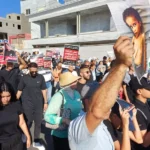
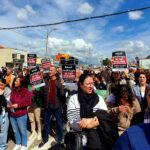
The call issued by Social Workers for Democracy to attend demonstrations against settler terrorism in Tel Aviv highlights the potential to mobilise professional protest groups that organised under the Netanyahu government and the far right, such as the White Coats.
This is a tendency that should be expanded. Efforts should be made to organise solidarity delegations to the West Bank composed of worker representatives from the social workers’ union and other organisations, followed by workplace meetings at which participants can report back and provide updates.
Ultimately, confronting the machinery of incitement, persecution, and repression maintained by the occupation and the rule of capital requires mobilising the social power of the working class on both sides of the Green Line.
The Dignity Strike, organised in May 2021 in protest against nationalist attacks led by settler gangs against Palestinian communities in the West Bank, as well as against communities, neighbourhoods, and homes belonging to Palestinian citizens of Israel within the Green Line, remains an important example in this respect. The joint protests organised at the time by Jewish and Arab workers in hospitals can likewise serve as inspiration for action against far-right terrorism.
Even if the government of Benjamin Netanyahu, Itamar Ben-Gvir, and Bezalel Smotrich is defeated in the elections and replaced, an alternative capitalist government of occupation will offer no solution. Settler terrorism cannot be uprooted without overthrowing the occupation and dismantling the settlement project.
The aggression of the army and settlers in the West Bank cannot be stopped without overthrowing the dictatorship of capital, imperialism, and national oppression, and advancing equal rights to existence, self-determination, and a life of dignity, well-being, and personal security for all.
A broader struggle for fundamental change is needed: for an independent, democratic, socialist Palestinian state with equal rights for all, and for socialist and democratic change in Israel and throughout the region.