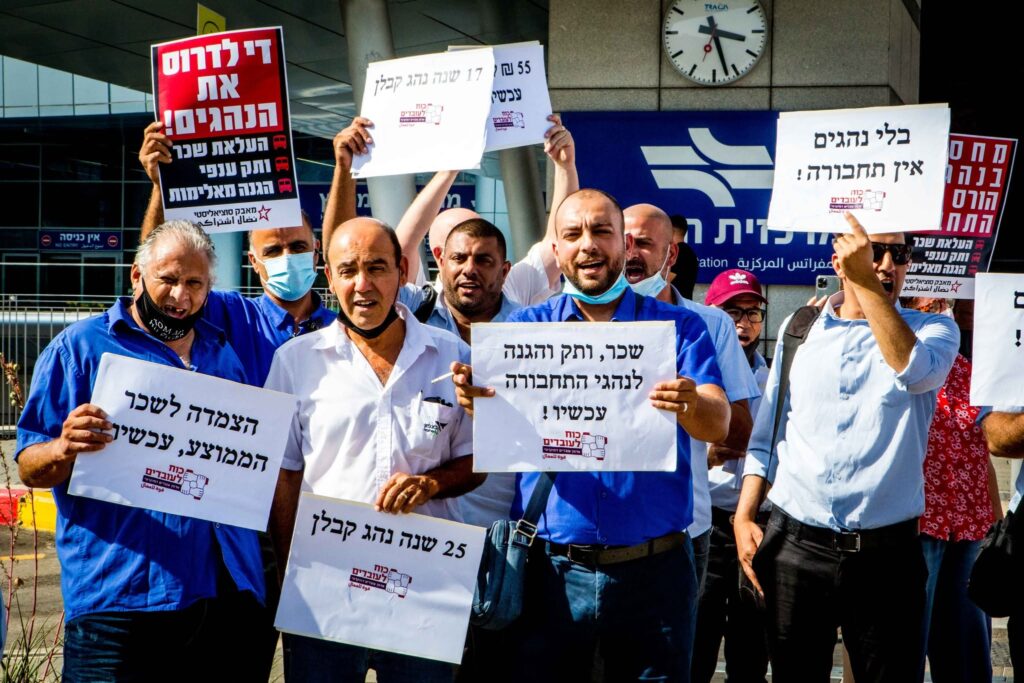
Public transport drivers, both Jewish and Arab, have seen their wages cut sharply during the recent war against Iran (which has still not been ‘concluded’, even after the announcement of a ‘ceasefire’ on 8 April).
The furlough scheme set by the Ministry of Finance for the entire economy, covering the period from 1 March to 14 April, provided only partial compensation to drivers who were entirely unable to work — resulting in the loss of tens of per cent of their monthly income. Meanwhile, drivers who were required to work on a part‑time basis, under the threat of missile fire, are not entitled to any compensation at all and are expected to make do with meagre pay for the hours they were actually able to work.
Warning strike
Public transport workers’ committees warned at the outset of the attack on Iran that the wages of around 98% of drivers were expected to be hit. The Public Transport Workers’ Union in the Power to the Workers union federation (Koaḥ LaʿOvdim) announced a several‑hour warning strike at Superbus and Electra Afikim, demanding full pay and a risk supplement for working during wartime. The first warning strike was scheduled for 4 June, between 05:00 and 08:00, with a possible escalation planned for 11 June between 12:00 and 16:00.
On 3 June, a day before the strike action was due to begin, Superbus reached an agreement on wage payments, reimbursement of holiday days and a limited risk supplement. The sums are to be transferred over the coming months, even though Superbus has already received some compensation from the government. The other companies in the privatised sector have so far refused to transfer any payment to workers who risked their lives and lost income. The struggle continues.
While the reduction of public transport during the war has forced drivers to absorb significant wage cuts, the driving that does continue takes place under real danger. In March, ʿAli Qadura, an Egged employee from the village of Naḥf in the Galilee, was seriously injured when a missile struck directly next to the bus he was driving in Kiryat Shmona.
The absurd situation in which drivers are required to risk their lives for only partial pay had already sparked a struggle in June last year, during the ‘12‑day war’ against Iran. Then, just hours before a planned strike by some of the drivers, a budget was transferred to cover full wages and a risk‑payment supplement — evidence of the power inherent in organised workers’ action.
The logic of profit
Following the declaration of a labour dispute, a discussion was held in May in the Knesset’s Economic Affairs Committee. It emerged that the Ministry of Transport, while refusing to commit to full compensation for workers, had transferred a budget for partial compensation to the operating companies. These companies did not bother to pass on even a single shekel of it to the drivers, conditioning any payment on receiving further compensation for themselves. Once again, it became clear that under market logic, public funds do not go towards improving public transport, but towards maximising corporate profits.
The Public Transport Workers’ Union in Power to the Workers wrote: ‘The Ministry of Transport has already transferred most of the compensation money to the companies… but they refuse to pass any of it on to the drivers. Where’s our money? We’ve shown maximum restraint, but the disregard continues, and we’ve no choice but to launch a warning strike — drivers are simply fleeing the sector!’
Insisting on full compensation — nothing less
The chair of the Public Transport Workers’ Division in the Histadrut’s Transport and Ports Union, Uri Metuki, remarked in the Knesset discussion that ‘it’s a shame the transfer of funds didn’t come with a demand to pass them on to the drivers immediately’. Instead of expressing regret, he should join the labour dispute now, ensure the money is transferred, and lead steps to harness the power of the organised workers in the Histadrut towards building a broad struggle aimed at achieving deep change in the intolerable state of the sector.
Transport Minister Miri Regev, the ‘fully right-wing’ government’s policies, and all public transport companies bear responsibility for the systematic harm caused to drivers and to an essential social service.
Even in normal times, public transport is far from meeting the public’s needs. It is characterised by under‑development and poor service, while under slogans of ‘increasing competition’, the policy of all recent capitalist governments has been to divide the operation of public transport among a growing number of private, profit‑driven companies — and to subsidise them. These companies strive to maximise their profits at the expense of workers, passengers and environmental considerations.
Poor working conditions and low pay have also created a severe shortage of drivers, who in their daily work face rising levels of street violence — a situation made worse by nearly three years of catastrophic wartime crisis. Palestinian drivers are furthermore targeted in serious racist attacks. Now, the government hopes to ‘import’ more drivers from abroad as cheap labour, accelerating the race to the bottom.
A struggle for deep change in the sector is needed
Drivers organised in Power to the Workers have drawn a red line and pointed towards building a struggle necessary for all workers in public transport. A fight for full compensation can indeed succeed in pressuring the government and the operators.
Potentially, the struggle for full compensation could be a step forward in building a broader campaign to secure a permanent mechanism for compensation and cost‑of‑living adjustments, and for deep reform in the sector — including improved conditions, recognition of drivers as public employees as a step towards their integration into the public sector, and comprehensive action against violence towards drivers and passengers.
The situation in the sector highlights the need to strengthen cross‑union cooperation among workers’ committees, and to plan assemblies for discussion and decision‑making on demands and forms of struggle. It is also necessary to reach out and systematically organise migrant workers in the sector, demanding full equality in pay and working conditions, and improving conditions for everyone without ‘divide and rule’.
Such a broad struggle will also require a public information campaign exposing the government and the operators, and the wasteful, exploitative profit logic of the privatised and subsidised sector. It should call on the wider public to support and act for public transport as a non‑profit social service, operated without fares. Ultimately, public transport requires substantial public investment and should be publicly owned and run under democratic public oversight — to protect the livelihoods and safety of drivers, and the service and safety of passengers, and to enable investment in green infrastructure.