Tareq al-Hadhalin is an English teacher, 31 years old, from the Palestinian village of Umm al-Kheir in Masafer Yaṭṭa. As in the other Palestinian villages in the West Bank in general and in Area C in particular, the community in Umm al-Khair also faces attacks by settler gangs and by army forces intended to advance the expulsion and ethnic cleansing of the area.
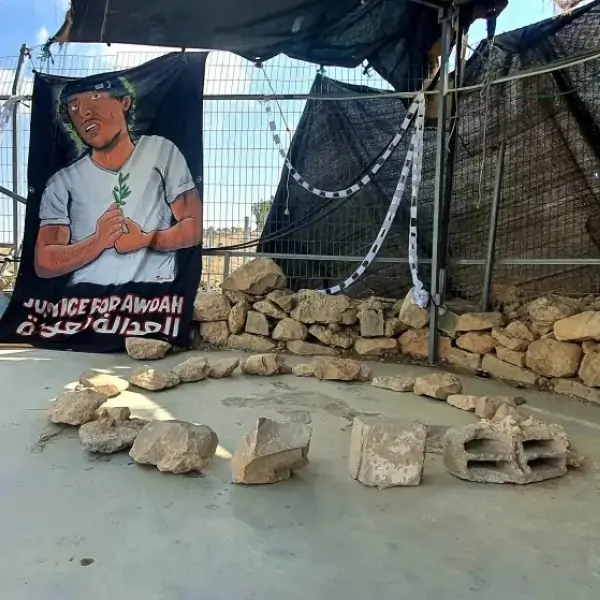
ʿAwdah al-Hadhalin, Tareq’s cousin and close friend, was murdered at the end of July by the settler Yinon Levi, who invaded the village with additional settlers in order to carry out infrastructure works for the establishment of an outpost. The occupation forces seized ʿAwdah’s body and released it only after 10 days, following a struggle that included a hunger strike by the women of the village. Within a month the settlers placed the first caravans at the site of the murder. The next day, on 28 August, we, activists of SSM, arrived for a visit in the village and heard about the community’s struggle against the organised terror, the transfer plans, and the imposition of poverty by the occupation regime and the Israeli capitalist death government.
At the end of October 2025, about two weeks after the interview, the occupation authorities issued demolition notices for approximately 14 buildings in the village, most of them residential houses, in addition to the Umm al-Khair community centre, which includes a health clinic and a children’s playground. Around one hundred people now face an immediate danger of losing their shelter.
What has happened in the past weeks, since our visit to the village?
Tareq: The settlers placed another 3 caravans and now there are seven. When they began digging in order to connect them to electricity and water, they cut our connection to water and electricity. All of it in the presence of the police, the Border Police, and the army, who were full participants. We were more than a hundred people, three days and three nights without water and electricity. We had elderly women who needed an inhalation device that runs on electricity, there were medicines in fridges, babies who need milk and equipment that requires electricity and water.
The one who drove the bulldozer that cut the electricity was Yinon himself — the terrorist who murdered ʿAwdah. It is not accidental, there is planning here by the whole system, from the top of the pyramid down to the smallest person like Yinon. They tell him: “Go, go back there, provoke them, make them react, do something”, and then they will use it as a security pretext to expel us.
Before dawn on 7 October 2025 they raided the village, the regular army, together with settlers in uniform from the standby squads of the settlements in the area. They uprooted and sawed more than one hundred and fifty olive trees, destroyed everything. The regular army imposed a closure on the village, prevented movement, and locked people in their homes. They arrested the head of the council, Khalil — for three or four hours he was held at the Susiya base, his hands shackled and his eyes covered.
The goal was clear: they wanted to pave a road from the new caravans that were placed inside the village that would connect them to the settlement of Carmel. By sunset they had already built it, through the village (on the land where the olive trees had been) up to the caravans, and they fenced the whole area. We lost more than 7 dunams of land in the incident. Now we are forbidden to enter there, it is only for the settlers.
On 12 October the Jerusalem District Court issued an order following a petition by the lawyers who represented us, and ruled that all construction work in the caravans must be stopped immediately, and that no one is allowed to live in them. The order was issued during the day. But at night they began working and by six in the morning settler families had already arrived and moved in. Four settler families moved to live there, all originally from the settlement of Carmel.
Trump is now being presented in the media in Israel and around the world as a “dove of peace” in light of the temporary ceasefire in Gaza… what do you think of this description?
Tareq: How can someone who is a partner to war crimes, to crimes against humanity, to murder crimes, bring peace? Trump is the great criminal. As soon as Trump returned to power, he removed all the sanctions from the settlers (including Yinon Levi himself, who murdered ʿAwdah al-Hadhalin). He believes that all of Area C should belong to the settlers, and that the Palestinians can go. Of course everything is done by the Israeli occupation and the settlers — with US funding, with US weapons, and with Western support.
Their goal is to kill hope among the residents — to destroy the sense of security, so that we will be afraid and leave here. But we in Umm al-Khair will continue until the very last moment. We have no other choice. Unless they come — as they did in Masafer Yaṭṭa in the 1990s — bring buses and lorries, load our belongings, expel us by force and at gunpoint. Otherwise, we are not leaving here.
What is your message to ordinary Israelis, workers and young people, who demonstrated against the government for the return of the hostages, or against anti-democratic attacks, to change their living conditions, but most of whom do not speak about the occupation, or perhaps do not even know what is happening in Masafer Yatta and the West Bank?
Tareq: I invite them to come visit us in Umm al-Khair. We welcome everyone, ready to sit, talk, explain the reality and show the facts on the ground. I tell them that if you muster courage and think outside the box, you can change your point of view on everything that is happening, you will discover that this thing is not far from you. Whether you are in Tel Aviv, in Beersheba, in Haifa or in Jerusalem — it is not far. Every person has a right to life, a right to security. So if we are talking about democracy and about human rights, let us apply it in reality, on the ground. We need to stand together against settler violence. We must stand against the apartheid regime, against the destruction. Support that lifts morale, not only material aid. It is not only about donations, but about standing alongside people. It gives strength, it empowers.
And in the end — the apartheid regime will fall. When and how? I do not know. But when it falls — it will be excellent to know that we brought it down, the effort of the young people, thanks to the joint struggle and the joint resistance.
Solidarity with the struggle of the Umm al-Khair community, justice for ʿAwdah al-Hadhalin and all victims of settler terrorism! No to expulsion, no to transfer and no to annexation. Dismantle the Kahanist terror outposts and the entire colonial settlement enterprise. Struggle to bring down the dictatorship of the occupation, to bring down imperialism and the rule of capital. Yes to the struggle for reconstruction, welfare, and equal right to self-determination in the context of a revolutionary socialist transformation.