The final results have not yet been confirmed, but it is already possible to determine that on election day we witnessed a ballot box revolt cutting across national communities against the government of bloodshed, after four years of disasters, atrocities and mass protest movements. This revolt was reflected in a surge in voter turnout, expressing the depth of mass disgust with the status quo, particularly under the impact of the catastrophic war crisis, but also the strangling cost of living and burning social problems. Masses voted from the Negev/Naqab to the Galilee in order to remove Netanyahu and the far right.
Voter turnout among Palestinian citizens of Israel illustrated a sense of urgency in the face of threats of transfer, house demolitions, enforced poverty, violence by organised crime gangs, and after three years of genocidal war in Gaza. This protest vote against the government has translated into a record level of Palestinian representation in the Knesset, primarily through the Joint List.
According to the near-final results, the Netanyahu bloc ends the election with around 53 seats, a plunge of 11 compared with the 2022 election. Ben Gvir’s Kahanist aide explained the blow suffered by Netanyahu’s bloc at the ballot box with the conclusion that ‘the people of Israel are stupid’! Yet Netanyahu’s bloc is nevertheless in a dangerous position to present a picture of a ‘victorious defeat’, not only through aggressive de-legitimisation of the Arab vote and the Trump-style fabrication of claims of election theft, but also because Eisenkot’s capitalist ‘change bloc’ failed, having managed to secure even fewer votes…
In his ‘victory’ speech, Eisenkot declared his vision: not an end to endless war, inequality and cost-of-living exploitation, but the establishment of a ‘Zionist mobilisation government’. In other words, a government that would seek to supply more young people as manpower for the war machine, and continue an endless war in defence of the occupation, inequality and the rule of capital. The parties of the ‘change bloc’ benefited from a ‘lesser evil’ vote, but were incapable of inspiring hope for profound change in people’s living reality, including living conditions. Instead, they mainly promised to lead symbolic measures for a state commission of inquiry and legislation to block Netanyahu from remaining in office.
It is no surprise that they struggled to attract support from disappointed Netanyahu-bloc voters among the Jewish working class, who identify the ‘change bloc’, to a considerable degree justifiably, with the establishment and the ‘old elites’. Eisenkot’s bloc competed with the ‘full-on right-wing’ government over who could better maintain the occupation, the settlements and regional military aggression under the cover of security demagogy and cynical exploitation of 7 October. For that reason, it is also largely unwilling to ‘sit with Arabs’ in government.
The ballot box revolt expressed a mass desire for profound change, but it also exposed a sharp contradiction: the inability of Eisenkot’s bloc to provide an answer to those aspirations. The absence of an alternative leadership on the left in society, embodied in struggles and organised power on a cross-community basis among working-class people, offering a way out of endless war, strengthens the picture of a dead end.
Even if a government modelled on the Bennett-Lapid ‘government of change’ is once again formed, which some described as a ‘Jewish-Arab government’, a government led by Eisenkot’s bloc will not solve a single one of the burning crises facing society. But what needs to be done now?
The battle to remove Netanyahu has not yet been decided. Netanyahu is threatening a renewed assault on Iran and is inciting against the Arab-Palestinian public in order to promote the de-legitimisation of the civilian majority that voted against him. The racist spin about a ‘Jewish/Zionist majority’ was also fuelled by the leaders of Eisenkot’s bloc throughout the election campaign.
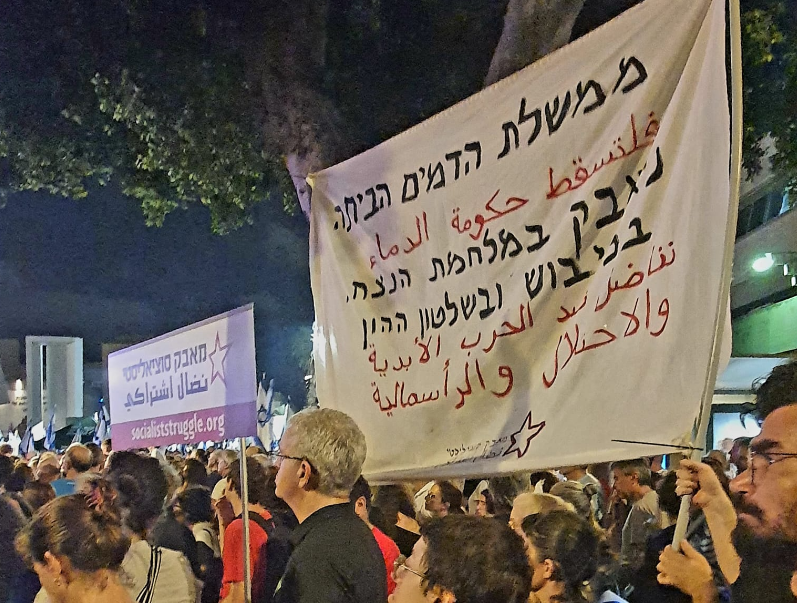
What is needed now is to organise for struggle — including in the streets, and potentially also with strike actions — against any attempt by the caretaker government to drive military escalation and manoeuvre its way into entrenching itself in power.
If the Joint List tactically enables a minority government led by Eisenkot to take office in order to remove Netanyahu, it should warn that this is a capitalist occupation government and that it is necessary to build a struggle against it, as well as a cross-community political alternative rooted in the working public. No binding agreement of any kind for ‘industrial peace’ with a centre-right government should be concluded with Eisenkot’s bloc. Any tactical vote to block Netanyahu should be accompanied by a call to prepare for struggle in the streets against the policies that a centre-right government is expected to advance: military escalation, war budgets, cuts, a worsening cost-of-living crisis, and the perpetuation of the occupation and the settlements.
The continued construction of the struggle to remove Netanyahu and the far right must therefore be linked not to calls in favour of a capitalist ‘Jewish-Arab’ occupation government, but to the struggle for an alternative to endless war, the occupation and the rule of capital.